Stay with my current team
- What it offers
- Build a finished case study from an existing task.
- What it costs
- Risk of staying disengaged without changing the assignment.
A fictional six-card decision reading with evidence, comparison and a completed follow-up.
Fictional worked example · selected demonstration cards · no purchase or real customer record
For this example, stay with the current team for now and test the project’s scope before committing to the move. This is not a claim that staying will succeed. It is the option that better respects the stated limit of two extra hours while key information is missing.
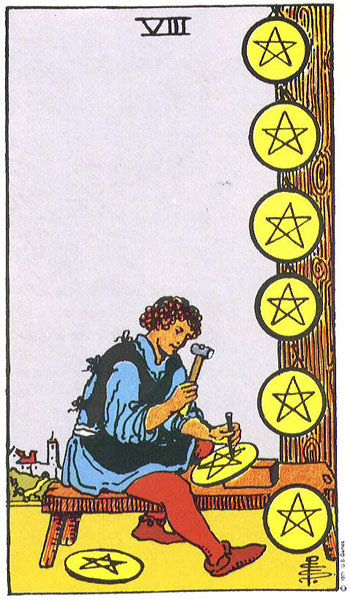
The craftsperson repeats a careful task.
The Eight of Pentacles in A’s opportunity position suggests a place to build visible skill through repetition. Staying can serve the portfolio goal if one existing task becomes a finished case study; staying without choosing a task would miss that opportunity.
Choose one current task to document from brief to result.
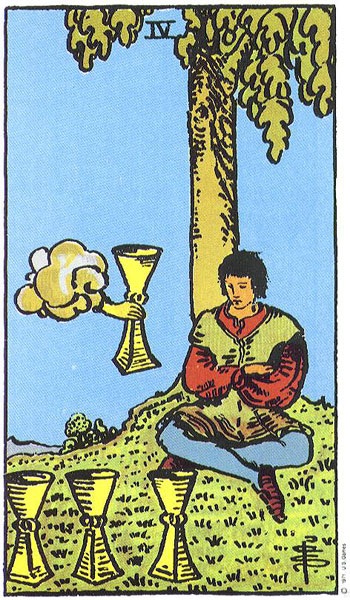
A seated figure overlooks an offered cup.
The Four of Cups in A’s cost position points to disengagement, not proof that the current team is a dead end. Familiarity can make a workable learning opportunity hard to notice. Treat repeated boredom as a signal to change the assignment, rather than evidence that every alternative is better.
Ask for one small change in responsibility and observe your response.
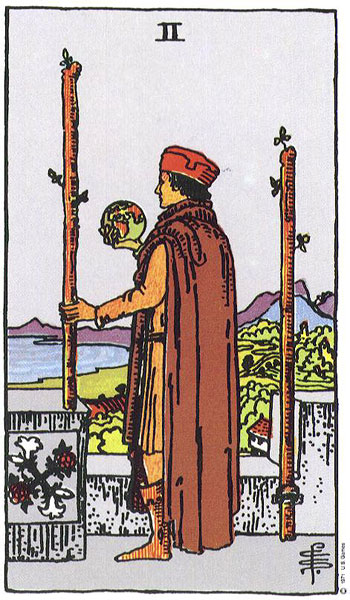
A figure holds a globe while looking outward.
The Two of Wands in B’s opportunity position represents a wider horizon and deliberate planning. The new project could broaden your work, but the card’s viewpoint is still one of assessment. Interest is a reason to ask for a plan, not proof of a suitable role.
Request a written deliverable and the person who will approve it.
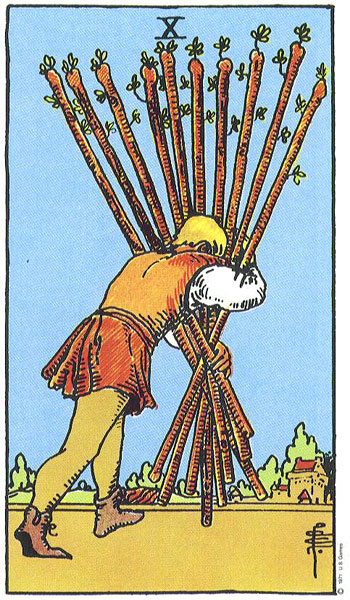
A figure carries a bundle that obscures the path.
The Ten of Wands in B’s cost position highlights the load hidden behind an attractive promise. With a two-hour limit, unclear responsibility matters more than enthusiasm. This is a risk to verify, not a prediction that the project will exhaust you.
Estimate preparation, meetings and revisions as well as production time.

The Moon lights a path whose far end is unclear.
The Moon in the shared blind-spot position suggests that both options are being compared with incomplete information. The current team is familiar but its flexibility is untested; the new project is appealing but its workload is unknown. Neither fear nor excitement fills those gaps.
Separate what was promised in writing from what you inferred.

Temperance pours carefully between two cups.
Temperance in the next-step position favors a measured experiment. Combine a clear boundary with a small trial instead of treating the decision as irreversible. An agreed four-week test could reveal whether the work fits; it is useful only if the hours and exit point are accepted.
Propose one bounded trial, with a weekly two-hour cap and a review date.
You are comparing the current team’s everyday reality with the new project’s possibility. Ask both sides what can actually change before deciding.
Reconsider B if the project lead agrees in writing to a deliverable, a two-hour weekly cap and an exit after four weeks. If the current team cannot offer any useful work, that also weakens A.
The Eight of Pentacles and Two of Wands both support development, but at different distances from execution. The Four of Cups warns against passive staying, while the Ten of Wands makes the missing workload agreement decisive. The Moon asks for facts; Temperance turns those facts into a reversible test. The recommendation is conditional on the stated time limit, not on an inevitable future.
What evidence would show that I am choosing learning, rather than only escaping boredom?
Test whether the new project fits my limit
What has the project lead said about the weekly commitment?
There is no estimate yet; they have only asked me to join the weekly meetings.
The added detail confirms that the new role’s workload is still undefined. It does not tell us whether the team will accept a boundary.
The Two of Wands remains an opportunity to explore, not a completed plan. Before you move, ask what work happens outside the meeting and how revisions are handled.
The Ten of Wands matters because the two-hour limit includes meetings. A one-hour call could leave only one hour for the actual project. This is an arithmetic and agreement problem, not a verdict about the people involved.
Ask for a four-week test covering one deliverable within two total hours each week. If that is accepted, reassess B. If the answer stays vague, remain with A and finish the case study. The cards have not changed; the missing condition is now clearer.
This example’s clarification is complete. A real reading includes one finite follow-up in the same visit, using the original cards. It is not an ongoing chat.
Fictional editorial example for reflection and entertainment. The cards do not establish facts or guarantee an outcome; this is not professional advice.