History · 11 min read
From Courtly Game to Reflective Practice: A History of Tarot
Follow tarot from fifteenth-century Italian card tables through French cartomancy, occult correspondence systems, the Rider-Waite-Smith deck, and today's reflective reading practices.
Start with what the evidence can actually support
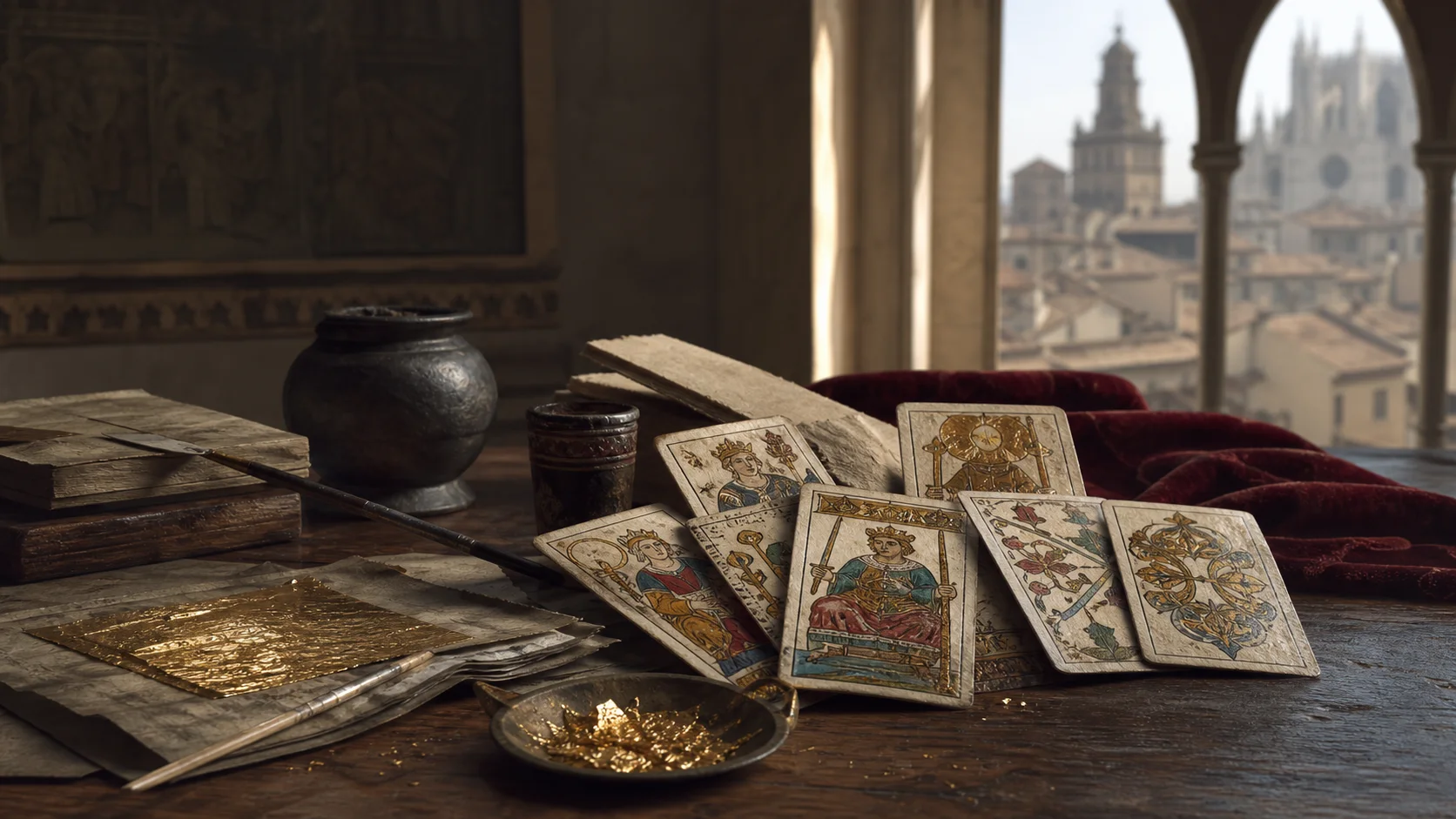
A useful history of tarot begins by separating surviving objects and documents from stories invented much later. The earliest secure references cluster in northern Italy during the 1440s and 1450s, especially around Milan, Ferrara, Florence, Venice, and Urbino. Account books, court records, poems, and surviving cards point to an established family of games by the middle of the fifteenth century. Because the game was already complex, historians reasonably suspect an earlier period of development, but the evidence does not justify pushing tarot back to ancient Egypt, biblical times, or an unknown prehistoric school. Those origin stories belong to the history of occult interpretation, not to the origin of the cards themselves.
This distinction matters because tarot is often presented as if one unbroken secret doctrine produced every image and meaning. The material record shows something more interesting: makers borrowed familiar card suits, courtly ranks, moral virtues, religious figures, civic symbols, and images of fortune or mortality, then arranged them for play. The cards changed as they moved between patrons, workshops, cities, printers, and readers. Tarot has continuity, but not a single frozen essence. A single image can carry Renaissance social meaning, nineteenth-century occult meaning, twentieth-century artistic meaning, and personal meaning. Recognizing those distinct layers makes the deck easier to study without pretending they are identical.
The first tarot packs were made for play
Fifteenth-century Italian packs used four familiar suits—Cups, Swords, Batons, and Coins—with cards numbered from Ace through Ten and four court ranks in each suit. That produces fifty-six suited cards. Tarot added a separate sequence of twenty-one picture trumps and a Fool, creating the broad seventy-eight-card structure still recognized today. In a trick-taking game, the trumps outranked ordinary suited cards, while the Fool had a special role that varied by local rules. The cards therefore had a practical grammar before they acquired a divinatory one: suit, rank, trump order, timing, memory, and strategic play determined what happened at the table.
The famous Visconti, Brambilla, and Visconti-Sforza groups survive because they were luxury commissions, painted on pasteboard with costly pigments, punched gold, and courtly detail. They should not be mistaken for the only tarot cards in circulation. Less expensive printed cards were played, handled, damaged, and discarded, so survival favors elite objects. The magnificent gold backgrounds tell us about patronage and workshop skill, not that tarot was restricted to a hidden priesthood. The Met identifies three important mid-fifteenth-century luxury groups connected with Milanese patrons; their surviving cards are now divided among institutions, making the modern idea of one pristine original deck historically misleading.
Early trump images belonged to a Renaissance visual world
The early trumps were not random illustrations. Emperors, popes, virtues, the Wheel of Fortune, Death, the Sun, Moon, Star, Judgment, and the World belonged to a visual culture that viewers already encountered in sermons, civic pageantry, manuscripts, frescoes, and moral allegory. A player did not need an occult handbook to understand that Fortune could raise and lower status, that Death leveled social rank, or that Temperance represented measured combination. The sequence dramatized worldly power, instability, ethical ideals, cosmic order, and final reckoning in a form that could be held, shuffled, and played.
At the same time, modern card titles should not be projected backward without caution. The figure now called the Hanged Man was often understood through the image of a traitor displayed upside down. The High Priestess is related to the earlier Popess, a figure with a complicated religious and satirical history. The exact order and contents of trump sequences varied, and some early packs included additional virtues or unusual court structures. These differences undermine the claim that the twenty-two cards always encoded one universal initiatory path. They also invite better reading: before declaring a symbol timeless, ask what that symbol meant to the community that first used it and how a later deck has deliberately revised it.
There was no single original deck or numbering system
Modern learners often memorize a fixed order from the Fool at zero to the World at twenty-one. That order is useful within a chosen deck tradition, but historical packs were less uniform. Regional game traditions developed different trump rankings, and individual luxury packs could add, omit, or reshape figures. Even later occult decks disagree: Justice and Strength exchange numerical positions between influential systems, while suit names, court titles, and the visual treatment of pip cards vary widely. Marseille-style decks generally repeat suit emblems on numbered Minor Arcana cards; Rider-Waite-Smith descendants usually stage full scenes; Thoth-derived decks use another vocabulary again.
The practical lesson is not that every convention is arbitrary. It is that meanings are carried by systems. If a deck swaps a number, renames a court card, changes Coins to Pentacles, or gives the Eight of Cups a radically new scene, read that choice as part of the deck's argument. Use the guidebook and image in front of you instead of importing a remembered keyword from a different tradition. Historical awareness makes comparison precise: you can ask which features are old structures, which are nineteenth-century correspondences, which are the artist's intervention, and which are habits created by contemporary reading culture.
Cartomancy and occult tarot arrived centuries later
People used ordinary playing cards for divination before tarot became strongly associated with fortune-telling, but tarot's occult identity took shape much later than the game. In eighteenth-century France, Antoine Court de Gébelin proposed that the trumps preserved ancient Egyptian wisdom. His theory was influential and historically unsupported. Jean-Baptiste Alliette, better known as Etteilla, developed systematic cartomantic meanings and produced a deck intended for divination. The shift was decisive: tarot was no longer only a game whose images could prompt associations; it became a deliberately organized technology of correspondences, spreads, upright and reversed meanings, and professional reading.
Nineteenth-century occultists expanded those correspondences. Writers such as Éliphas Lévi connected tarot with Kabbalistic, astrological, magical, and initiatory frameworks. Later groups, including the Hermetic Order of the Golden Dawn, assigned letters, planets, zodiac signs, elements, colors, and ritual meanings across the deck. These systems were intellectually ambitious syntheses rather than recovered fifteenth-century rules. Calling them later inventions does not make them useless. It lets a reader evaluate them honestly: a correspondence can be coherent within its school, artistically fertile, and powerful in practice without being proof of an ancient Egyptian origin.
Pamela Colman Smith changed how the Minor Arcana could be read
In 1909, Arthur Edward Waite commissioned artist Pamela Colman Smith to create seventy-eight images for a deck published by Rider. Smith was already an experienced illustrator and theater designer. Her contribution was not decorative execution of someone else's complete script. The Morgan Library emphasizes her independent artistic career, while her cards show decisions about staging, gesture, costume, rhythm, color, and emotional ambiguity. The deck is increasingly called Rider-Waite-Smith or Waite-Smith so the publisher, occult planner, and artist are not collapsed into one male name.
Smith's most consequential choice was to give the numbered suit cards complete scenes. Earlier painted and Marseille-style pips often foreground the repeated suit objects; Smith's Five of Pentacles places two struggling figures outside a lit window, while the Eight of Cups shows a solitary departure under an eclipsed moon. A reader can now work from posture, distance, gaze, weather, architecture, and sequence even before consulting a keyword. The Sola Busca deck offered an important earlier example of illustrated pips, but the wide circulation of the 1909 deck made scenic Minor Arcana a dominant language for twentieth- and twenty-first-century English-language tarot.
The twentieth century multiplied tarot rather than standardizing it
Rider-Waite-Smith did not end tarot's evolution. Occultists, artists, publishers, feminists, spiritual communities, game players, therapists working with imagery, and independent creators kept redesigning the deck. Some preserved familiar compositions so readers could transfer learned meanings. Others challenged racial, gendered, religious, colonial, or bodily assumptions embedded in earlier imagery. Surrealists and contemporary artists treated the cards as a modular visual language. Mass printing made decks affordable; later, online publishing and crowdfunding allowed artists to reach small, specific communities without waiting for a traditional publisher.
As a result, modern tarot is plural. In parts of Europe, tarot games remain living games. Elsewhere the cards are primarily read for divination, spiritual practice, creative work, coaching, or journaling. These uses may overlap, but they should not be confused. A claim about how a card scores in a game is different from a claim about its Golden Dawn attribution, Smith's composition, or a reader's response to it. Responsible practice names the frame being used. It does not present one twentieth-century keyword list as the secret meaning that every deck and every historical player always shared.
History gives a reader better questions, not a final dictionary
Historical knowledge becomes practical when it changes how you look. Suppose the Wheel of Fortune appears in a career reading. A thin interpretation says “luck.” A historically alert reading notices the older moral image of status rising and falling, then asks what is cyclical, structurally unstable, or outside the querent's control. If the Five of Pentacles follows, Smith's scene adds material exclusion and visible help that may or may not be accessed. The reading can now distinguish market conditions from personal agency and ask where support is present, instead of predicting a lucky or unlucky outcome.
The same method prevents overconfidence. A reader can say, “In this deck, the image suggests withdrawal,” rather than, “This card has always meant abandonment.” You can compare the deck's guidebook, the card's historical family, the spread position, and evidence from the actual situation. Disagreement between layers is useful: perhaps a traditional triumphal Chariot is presented by a modern artist as exhausted control. That tension may be the point. History expands the available evidence while reminding the reader that interpretation is situated.
A compact method for reading any deck's lineage
Before using an unfamiliar deck, identify its family. Does it follow Marseille pips, Rider-Waite-Smith scenes, Thoth correspondences, a historical game pattern, or a genuinely independent system? Read the creator's statement. Compare the Fool, Lovers, Justice, Death, Tower, and World, then sample one numbered card and one court from every suit. Note changed titles, numbering, suit elements, repeated colors, and whose bodies or social roles are centered. This thirty-minute survey prevents accidental mixing of incompatible assumptions and reveals what the artist expects you to notice.
Then write three columns in a journal: inherited structure, artistic revision, and present question. Under inherited structure, record the suit, number, trump family, or established correspondence you are actually using. Under artistic revision, describe what this image changes. Under present question, name the detail that meets current reality. Tarot Bitio's card library can support the first and third columns for a Rider-Waite-Smith-based vocabulary. The final interpretation should still remain provisional: the cards are historical objects and living prompts, not proof that one symbolic system controls the future.
Historical sources and further reading
- The Metropolitan Museum of Art — Before Fortune-Telling: The History and Structure of Tarot Cards
- The Metropolitan Museum of Art — The Visconti-Sforza Tarot
- The Warburg Institute — Tarot: Origins & Afterlives
- The Morgan Library & Museum — Tarot! Renaissance Symbols, Modern Visions
- The Morgan Library & Museum — Pamela Colman Smith before Waite