Foundations · 11 min read
How a 78-Card Tarot Deck Is Structured—and How the Parts Work Together
Learn the functional architecture of Major and Minor Arcana, suits, numbers, and court cards, then use those layers to diagnose a spread instead of memorizing 78 isolated definitions.
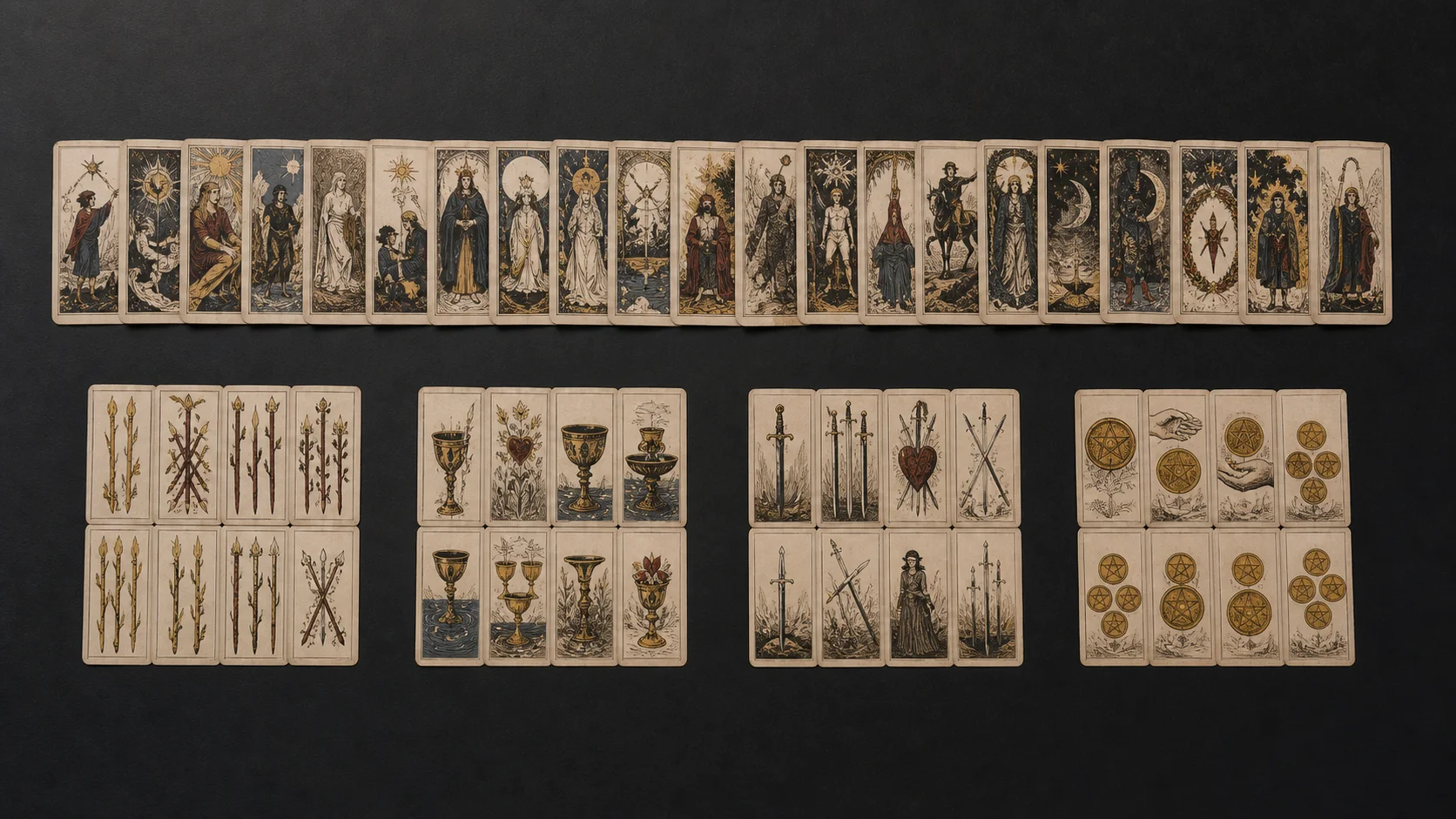
Treat the deck as a system, not 78 separate flash cards
A standard modern tarot deck has seventy-eight cards: twenty-two Major Arcana and fifty-six Minor Arcana. The Minor Arcana divide into four suits of fourteen cards, with ten numbered cards and four courts in each suit. That architecture is more useful than a list of keywords because every card sits at the intersection of several layers. The Three of Swords is not merely “heartbreak.” It is a Three, so it concerns development or the result of combination; it is a Sword, so thought, language, division, and judgment are active; and its specific image turns those abstract layers into a scene the reader can test against the question.
Learning the system reduces memory pressure. Instead of storing upright and reversed paragraphs for seventy-eight cards, start with four questions: Is this a Major or Minor Arcana card? What domain does the suit emphasize? What stage does the number or court rank suggest? What is physically happening in this deck's image? A conventional meaning can then refine the interpretation. This order keeps you from forcing a familiar keyword onto a picture that is doing something more precise, and it makes an unfamiliar deck readable even when its guidebook uses different language.
Major Arcana raise the scale of the question
The twenty-two Major Arcana contain the Fool and twenty-one numbered trumps. Their scenes concentrate recognizable human structures: choosing and attaching in the Lovers, organizing power in the Emperor, submitting to or revising tradition in the Hierophant, enduring disruption in the Tower, and integrating a long cycle in the World. When several Majors appear, the reading often concerns identity, values, a threshold, or a pattern that outlasts today's logistics. It does not necessarily mean a supernatural event or an unavoidable destiny. It means the issue has become structurally important to the reader.
Scale is not the same as severity. The Sun can illuminate a major demand for visibility, not simply promise happiness; the Devil can identify an ordinary but entrenched bargain, not literal evil; Death usually describes a transition whose practical details will be shown elsewhere in the spread. A single Major surrounded by Minor Arcana can act as the governing principle. Justice between the Seven of Cups and Eight of Pentacles, for example, asks the reader to turn many attractive possibilities into criteria and sustained work. The smaller cards show how the larger principle becomes behavior.
The Fool's Journey is a study tool, not an ancient rule
Many modern books teach the Majors as the Fool's Journey: an inexperienced traveler meets teachers, tests power and desire, passes through crisis, and reaches integration. The sequence can be a useful memory palace because it turns twenty-two images into a developmental story. Early tarot players, however, did not necessarily understand the trumps as one psychological biography, and historical orders varied. Use the journey as one interpretive lens rather than proof that every reading must progress neatly from card zero to card twenty-one.
Other groupings are often more diagnostic. Compare paired forces such as Magician and High Priestess, Emperor and Empress, or Sun and Moon. Group the social cards from Emperor through Chariot, the inward-turning sequence around Hermit and Wheel, or the disruptive and reconstructive movement from Devil through Star. In a spread, ask whether the Major is initiating, maintaining, breaking, or integrating a structure. The Tower in an advice position may ask for a controlled dismantling; the same Tower in an environment position may name external instability the reader cannot solve by positive thinking.
The four suits describe different kinds of evidence
Wands usually foreground ignition, initiative, creativity, ambition, competition, and the management of energy. Cups emphasize feeling, attachment, imagination, receptivity, grief, pleasure, and relationship. Swords emphasize thought, language, analysis, conflict, boundaries, truth claims, and the consequences of decisions. Pentacles emphasize the body, craft, money, work, health routines, home, time, and other material conditions. These are domains of attention, not rigid topic labels. A Cup can appear in a career spread when belonging matters; a Pentacle can appear in a relationship spread when labor or financial dependency is the real issue.
Suit balance gives a rapid spread-level diagnosis. Many Wands with no Pentacles can describe abundant enthusiasm without schedule, funding, or maintenance. Cups and Swords in conflict may show feeling and explanation talking past one another. A Pentacle-heavy spread can be stabilizing, or it can reveal that every question is being reduced to security. Missing suits are not automatically bad, but they are worth asking about. If a decision spread contains no Cups, has the emotional cost been excluded? If a relationship spread contains no Swords, is an overdue conversation missing from the system?
Numbers show the stage of a pattern
Aces present concentrated potential or a new point of entry. Twos compare, pair, balance, or hold a tension. Threes develop something through combination and make an emerging pattern visible. Fours establish a container, which can stabilize or stagnate. Fives disturb that container through conflict, scarcity, or necessary change. Sixes redistribute, recover, cooperate, or move out of the disruption. Sevens test position and judgment. Eights organize power, repetition, movement, or restraint. Nines bring a pattern toward intensity and individual reckoning. Tens complete the cycle, sometimes as fulfillment and sometimes as excess that cannot continue.
This grammar is deliberately broad; the suit and image determine its form. The Four of Wands establishes a celebratory threshold, while the Four of Cups shows emotional enclosure and disengagement. The Eight of Wands accelerates movement; the Eight of Swords depicts a restrictive mental or social frame; the Eight of Pentacles develops skill through repetition. When the same number repeats across suits, look for a shared developmental stage. Three Fives do not mean three unrelated misfortunes. They suggest that instability itself is the spread's organizing condition, so the useful question becomes what kind of structure has failed and what must be rebuilt.
Court cards describe modes of participation
Pages tend to encounter a suit as message, curiosity, beginnerhood, or unformed capacity. Knights mobilize it: they pursue, deliver, defend, test, or overidentify with the suit's momentum. Queens internalize and sustain the suit through judgment, relationship, stewardship, or embodied mastery. Kings externalize and organize it through authority, standards, direction, or responsibility. These are functional modes, not fixed age, gender, appearance, or social status. A sixty-year-old executive can be a Page when learning emotional vocabulary; a child can show Queen of Pentacles competence in caring for a material routine.
A court card may refer to a person, but test that reading rather than assuming it. First ask, “What way of participating is needed here?” The Knight of Swords as advice may call for direct argument, or warn that speed is outrunning evidence. In an environment position it may describe a fast, adversarial workplace. In a relationship position it may identify a communication pattern, not a dark-haired stranger. When several courts appear, map their directions and suit relationships. A Queen facing a Page may show mentoring; two Knights turned away from each other may show incompatible methods even when their goals sound similar.
The image supplies verbs, relationships, and conditions
Keywords are usually nouns—hope, conflict, abundance—but readings become specific through verbs. In the Rider-Waite-Smith images, figures carry, refuse, offer, bind, wait, leave, build, defend, mourn, and look away. Describe those actions before interpreting them. Then note who acts and who receives, what is visible but unused, where figures face, what separates them, and whether the landscape opens or closes. The Six of Pentacles is not merely generosity; a standing figure distributes resources while holding scales, and two kneeling figures occupy unequal positions. The image can therefore raise questions about criteria, dependence, power, and the conditions attached to help.
Read relationships across cards as if they share one stage. Does the Queen of Cups look toward the guarded Nine of Wands or away from it? Does water appear, disappear, or become turbulent? Are tools being held competently in one card and dropped in another? Repeated colors, animals, architecture, hand gestures, and horizons can create a visual clause. Do not catalog every symbol. Select details that answer the stated question and spread position. A useful interpretation can point to visible evidence: “The two figures avoid eye contact while the advice card opens a direct exchange,” rather than “Communication energy is important.”
Use card distribution to diagnose the whole spread
Before interpreting card by card, count the structural signals. How many Majors, courts, and cards from each suit appear? Is the number sequence rising, falling, repeating, or jumping? Are most figures active, seated, bound, alone, or in groups? A six-card decision spread with three Majors and two courts may be less about choosing between job listings and more about authority, identity, and the roles the reader is willing to inhabit. A spread of low-numbered Minors may show an early-stage situation where experimentation is more honest than a final verdict.
Distribution is evidence, not a secret scoring formula. Four Swords do not automatically predict conflict, and the absence of Wands does not prove low energy. Use the pattern to ask a better question. If every card contains one isolated figure, examine whether the process lacks collaboration. If the sequence runs Ten, Nine, Eight, ask what is being simplified or unwound. If two cards contradict each other, do not average them into vagueness. Assign each card to its position: the Seven of Cups may describe many options, while the Emperor as advice asks for a rule that eliminates most of them.
Work an example from structure to synthesis
Imagine a three-card reading about improving a stalled creative project: Eight of Swords in the current position, Queen of Wands as the available resource, and Three of Pentacles as the next direction. Structure immediately shows movement from Sword to Wand to Pentacle—constraining thought, restored creative authority, then material collaboration. The numbers move from Eight to a court and back to Three, so the solution is not finishing alone through more effort. It is leaving a mature but restrictive frame, reclaiming a way of directing energy, and re-entering a developmental stage where work can be seen and improved with others.
Now add image detail. The bound figure in the Eight of Swords appears restricted but not fully imprisoned; the Queen of Wands sits visibly with sunflower and black cat; the Three of Pentacles shows plans being discussed in a built environment. A specific synthesis follows: the project may be stalled by private assumptions about what is allowed or ready, while the resource is confident authorship and the next step is structured critique with named collaborators. A practical action could be to send one imperfect section to two qualified readers with three precise questions. No isolated keyword would have produced that sequence of reasoning.
Study the deck in layers over four weeks
In week one, study the Major Arcana in small groups and write one sentence about the structure each card creates, preserves, disrupts, or integrates. In week two, compare the same number across all four suits; place the four Fives or four Eights side by side and describe the common stage before noting differences. In week three, follow one suit from Ace to Ten as a cycle, then compare Page, Knight, Queen, and King as four ways of participating. In week four, draw three-card combinations and write the synthesis before checking any guidebook.
Keep the exercises concrete. For every card, record one visible verb, one structural layer, one conventional meaning, and one question the card asks. Use the Tarot Bitio library to compare upright direction, reversed caution, practical advice, and reflection prompt, but rewrite the conclusion in your own words. The goal is not perfect recall. It is the ability to explain why an interpretation fits this card, in this position, for this question. Once you can show that chain of evidence, the seventy-eight-card deck stops feeling like a dictionary and starts behaving like a coherent visual language.