Beginner practice · 10 min read
Tarot Court Cards for Beginners: Read Roles, Not Stereotypes
Learn the sixteen court cards as behaviors and roles: suit domains, Page, Knight, Queen, and King across four suits, plus a fictional team-meeting example and a comparison exercise.
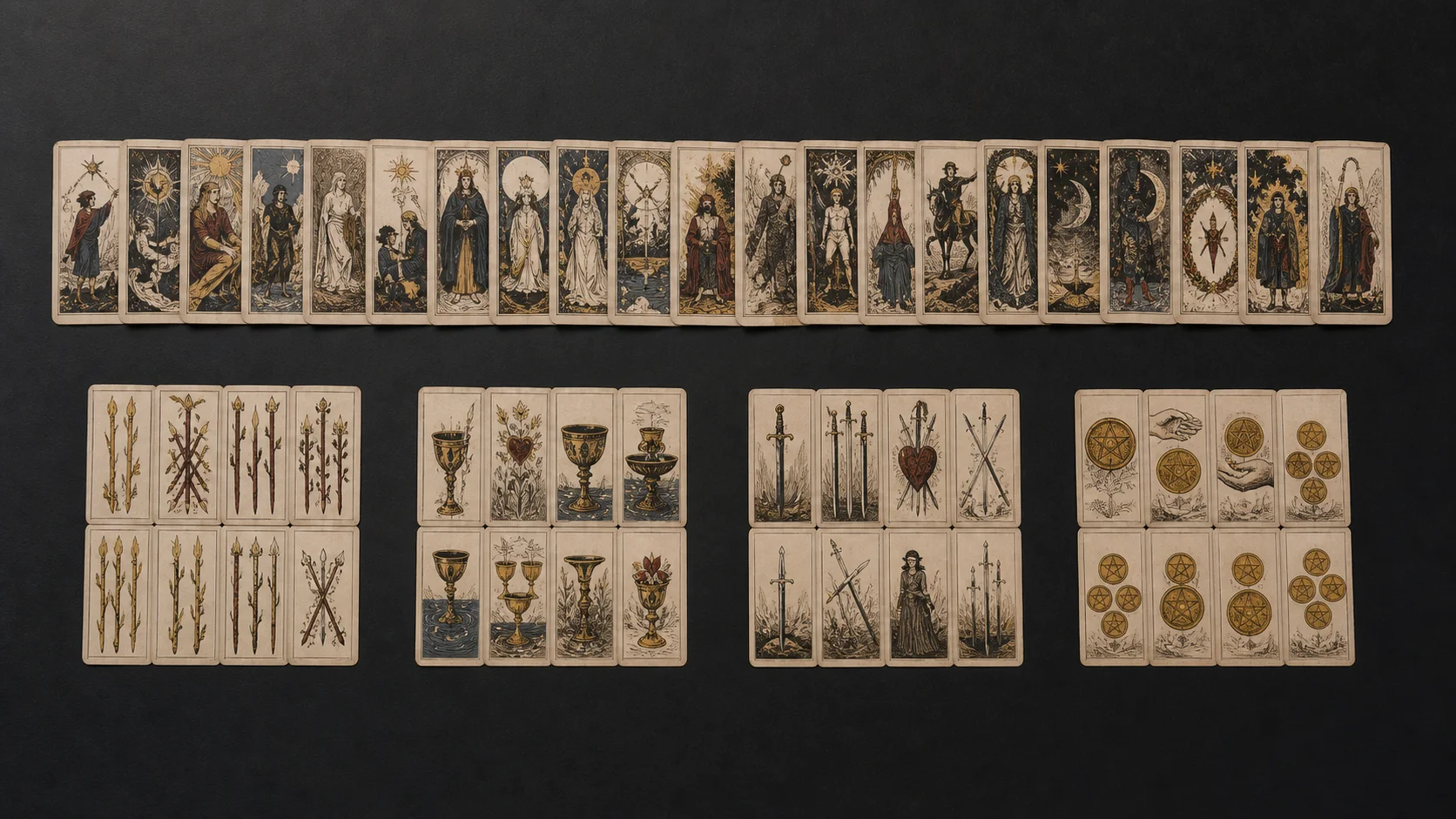
The sixteen courts as a working matrix
The Rider-Waite-Smith minor arcana contains sixteen court cards: Page, Knight, Queen, and King in each of the four suits, Wands, Cups, Swords, and Pentacles. Waite’s minor arcana text documents the familiar ranks as a historical source. The behavior-based method taught here is a modern practice framework, not a claim that Waite used these exact categories. Read the matrix as four ranks multiplied by four suits. The rank describes a mode of behavior or a role in a situation; the suit adds a domain of life. A court card is not a fixed personality type, a literal age, a gender, a skin color, or a secretly identified person in your life.
Treat each court as a small role that anyone can occupy for a while. A person can be a Page about a new budget, a Knight about a deadline, a Queen about a friendship, and a King about a team decision in the same week. The card shows how energy is being handled, not who someone essentially is. When a court appears, ask which behavior the position calls for and whether that behavior is present, missing, or excessive. This keeps the reading about observable conduct rather than about sorting people into permanent categories.
Suit domains as optional vocabulary
Wands often suggest initiative, drive, and visible action. Cups often suggest feeling, relationship, and what matters emotionally. Swords often suggest thought, speech, conflict, and decisions. Pentacles often suggest resources, work, money, the body, and tangible results. These domains are interpretive vocabulary, not empirical rules. A Swords card can appear in a warm conversation, and a Cups card can appear in a budget review. Use the domain as a first guess, then let the question and position refine it. If the suit meaning does not fit the actual situation, say so and read the rank instead.
The domains help you generate questions rather than conclusions. For Wands, ask what action is starting or stalling. For Cups, ask what feeling or relationship is involved. For Swords, ask what is being thought, said, or decided. For Pentacles, ask what resource, time, or practical step is at stake. Keep the domain provisional. A reading becomes easier to assess when you can explain why a suit meaning fits the evidence in front of you, and when you can drop it if the position points elsewhere.
Page: learning through small trials
The Page is the beginner's role: curious, willing to try, and not yet expert. In Wands, a Page might mean testing one bold idea with a short experiment. In Cups, it might mean naming a feeling for the first time or starting a gentle conversation. In Swords, it might mean asking a basic question or checking a fact before arguing. In Pentacles, it might mean beginning a small practical task, such as tracking expenses for a week. The Page learns by doing something modest and reviewing what happened.
The balanced limit of the Page is inexperience, not stupidity. A Page can be naive, easily distracted, or overexcited by a new possibility. The useful question is what small trial would produce real information without risking too much. If a Page appears in a position about a decision, look for a low-cost way to learn. If it appears about another person, do not assume they are young or immature; ask whether a learning stance is what the situation needs. The card describes a stage of practice, not a permanent rank of worth.
Knight: directed action and excess
The Knight is the role of directed movement: choosing a direction and acting on it. In Wands, a Knight might mean charging into a project with visible energy. In Cups, it might mean pursuing a relationship or expressing devotion. In Swords, it might mean arguing a case quickly or making a fast decision. In Pentacles, it might mean grinding through a long task steadily. The Knight is useful when something must move, and risky when speed outruns judgment.
The balanced limit of the Knight is excess. The same drive can become haste, obsession, aggression, or stubbornness. A Knight of Swords can cut through confusion, or it can wound people with careless words. A Knight of Pentacles can be reliable, or it can refuse to adapt. When a Knight appears, ask what is moving, how fast, and what is being ignored. The card does not prove that action is right; it shows that action is the theme. Check whether the pace fits the actual constraints and whether anyone affected has been consulted.
Queen: attentive stewardship
The Queen is the role of attentive stewardship: holding, tending, and responding to what is already present. In Wands, a Queen might mean sustaining morale and confidence in a group. In Cups, it might mean offering emotional care and listening well. In Swords, it might mean clear-eyed honesty and careful judgment. In Pentacles, it might mean practical provision, such as making sure people have what they need to work. The Queen notices details and keeps something alive over time.
The balanced limit of the Queen is over-attention or self-erasure. Care can become controlling, anxious, or endless. A Queen of Cups can be compassionate, or can absorb everyone else's feelings and neglect their own needs. A Queen of Swords can be perceptive, or can become cold and cutting. When a Queen appears, ask what needs tending and who is doing the tending. Check whether the caregiver has support. The card describes a mode of attention, not a gender role, and it does not rank anyone below anyone else.
King: responsibility and accountability
The King is the role of responsibility and accountability: setting direction, making decisions, and answering for outcomes. In Wands, a King might mean leading a venture and owning its results. In Cups, it might mean creating an emotionally safe environment and being answerable for it. In Swords, it might mean making a fair ruling and explaining the reasoning. In Pentacles, it might mean managing resources and being accountable for their use. The King is less about personal charisma than about taking ownership of a domain.
The balanced limit of the King is rigidity, isolation, or misuse of authority. A King can become controlling, defensive, or out of touch with the people affected by their decisions. A King of Swords can be just, or can hide behind rules. A King of Pentacles can be generous, or can hoard. When a King appears, ask who holds responsibility, what they are accountable for, and whether that responsibility is being shared or avoided. The card does not prove that authority is wise or that a man is involved; it points to the question of ownership.
Separating self, other, and role by position
A court card does not automatically mean a specific person. The spread position tells you what kind of subject to consider. A position labeled my behavior points to you. A position labeled the other party points to someone else, but only as a role they may be occupying, not as a fixed identity. A position labeled the situation or the needed approach points to a mode of action. Before naming anyone, read the position aloud and ask what evidence supports that assignment. If the position is unclear, treat the card as a behavior to examine rather than a person to accuse.
Use actual evidence to decide whether a role is present. If a Knight of Swords appears in a position about communication, look at what was actually said and how quickly. If a Queen of Cups appears in a position about support, look at who listened and who was heard. Do not use the card to diagnose a personality, to confirm a suspicion about a named individual, or to assign a permanent trait. The card offers a hypothesis about behavior that you can check against what happened. If the evidence does not fit, revise the reading rather than the person.
A fictional worked example: team planning meeting
This example is entirely hypothetical and uses deliberately chosen cards for teaching. A small team is planning a project meeting. In a three-position spread defined as the present resource, the tension, and the next action, imagine drawing the Page of Pentacles, the Knight of Swords, and the Queen of Cups, all upright. The Page of Pentacles in the resource position suggests a concrete, modest starting point: a short agenda, a small budget line, or one pilot task. It does not mean a young person or a new employee is the answer.
The Knight of Swords in the tension position suggests fast speech, sharp debate, or a decision being rushed before everyone has the facts. It does not prove that anyone is hostile. The Queen of Cups in the next-action position suggests attentive listening and emotional care as the practical next step: ask each person what they need before pushing the plan forward. A defensible synthesis is that the team has a small practical opening, a risk of rushed conflict, and a need for careful listening. The real action is to send a short agenda, invite one concern from each person, and set a checkpoint after the meeting to review whether the discussion stayed useful.
Exercise: compare suits and ranks
First, compare the same suit across all four ranks. Lay out the Page, Knight, Queen, and King of Pentacles. Write one sentence for each describing a different way to handle resources: the Page tries a small budget experiment, the Knight pushes a task through, the Queen tends to practical needs, the King is accountable for the money. Then do the same for Cups, Swords, and Wands. This shows how rank changes the behavior while the suit keeps the domain. Notice where your sentences overlap and where they genuinely differ.
Second, compare the same rank across all four suits. Lay out the four Knights and describe each one's directed action: Wands charges at a goal, Cups pursues a feeling, Swords argues a case, Pentacles grinds through a task. Then repeat with the four Pages, Queens, and Kings. After both comparisons, review your notes and mark any sentence that sounds like a fixed personality diagnosis or a ranking of people. Rewrite those sentences as behaviors with limits. Finish by choosing one card and naming a small real action you could take this week, plus the evidence you would check afterward.