Beginner practice · 10 min read
How to Read Tarot Symbols Without Memorizing Every Detail
Learn a beginner-friendly way to read Rider-Waite-Smith symbols: observe first, separate fact from tradition, and practise with a fictional Eight of Pentacles exercise.
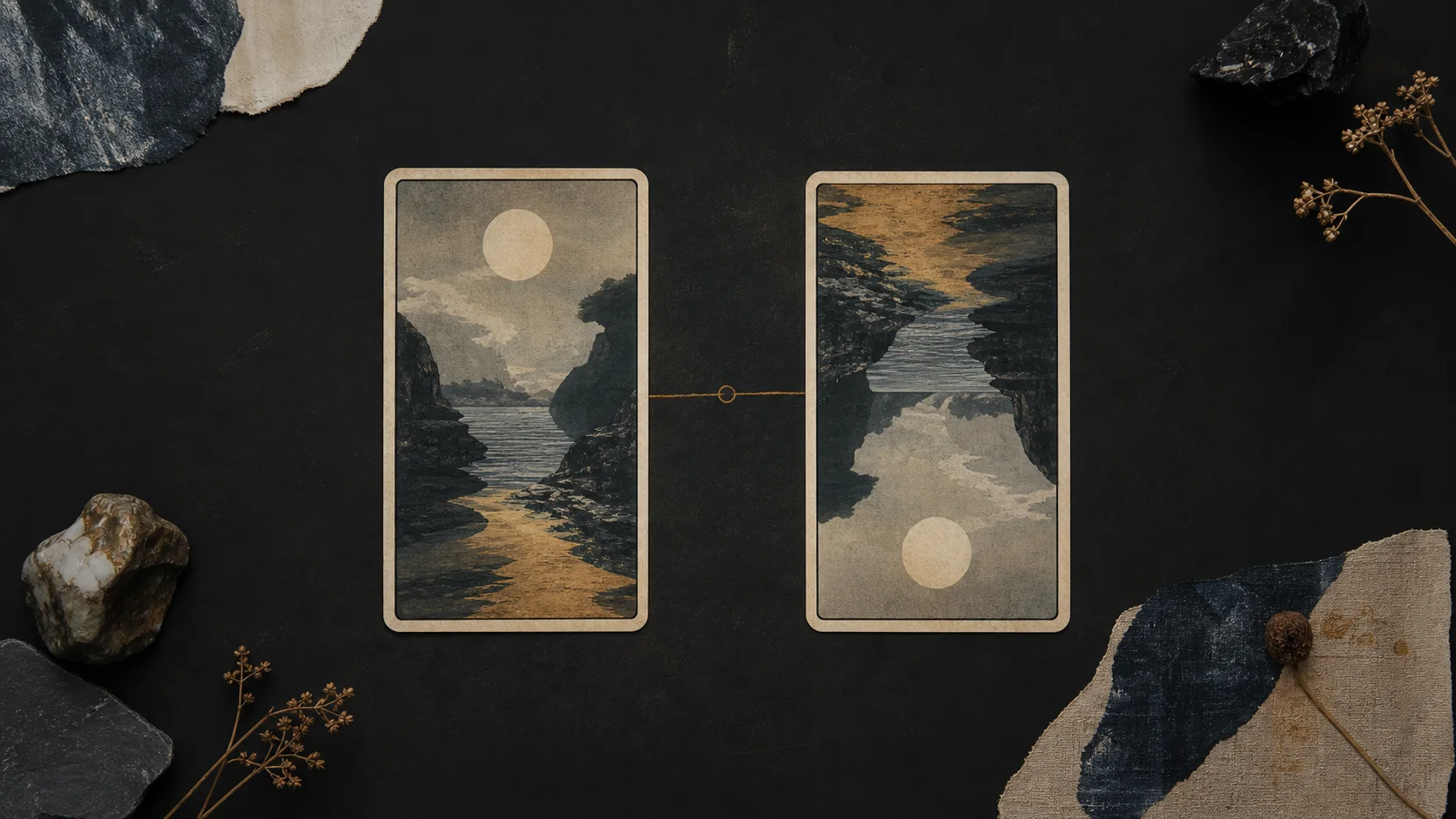
Identify the actual deck and artwork in front of you
Before interpreting anything, confirm which deck you are holding and which artwork you are looking at. The Rider-Waite-Smith (RWS) deck combines Pamela Colman Smith’s artwork with Arthur Edward Waite’s direction and written interpretation. Its scenes carry specific visual choices rather than generic tarot imagery. Many later editions reprint, recolour, crop, or redraw those scenes. A card from a themed deck may share the RWS title while showing entirely different objects, figures, and settings. If you assume the familiar scene is present when it is not, your reading drifts away from the card on the table.
Check the card name, the suit or major number, and any small printed marks. Note whether the image is a full scenic illustration or a simplified symbol arrangement. Some editions include keywords, astrological glyphs, or borders that the original did not. Write the edition name and year in your notebook if you know them. When you study an RWS example in a book or article, treat it as a reference to that tradition, not as a claim that your copy matches it exactly. Inspect your own card and describe what is actually printed there.
Make a neutral inventory before reaching for keywords
A neutral inventory is a plain list of what is visible, written without interpretation. Count the figures. Name the objects. Note what each person is doing, holding, wearing, or facing. Record the setting: indoors or outdoors, crowded or empty, built or natural. Include anything partially hidden, cut off by the frame, or placed in the background. Keep the language descriptive: “a figure kneels beside a low bench” rather than “a dedicated worker.” The second version has already added a judgement about character and motivation.
Do this inventory before you recall any traditional keyword. Keywords are useful shortcuts, but they arrive with associations that can override your eyes. If you list “sadness” while looking at a card, ask what visible feature produced that word: a downward gaze, a shadow, a closed posture, a colour. Then write the feature beside the word. This habit slows you down in a helpful way. It also gives you something concrete to compare when you later read a guidebook entry or discuss the card with someone who sees it differently.
Read posture, gesture, and gaze without claiming mental states
Posture, gesture, and gaze are observable. A figure may stand upright, lean forward, cross the arms, raise one hand, look away, or meet the viewer's eyes. These are facts about the drawing. What they mean is a separate question. A turned head might suggest avoidance, attention elsewhere, listening, or simply the direction the artist needed for the composition. You cannot verify a drawn figure's inner life, and treating a guess as certain makes the reading brittle. Describe the body first, then offer interpretations as possibilities.
When you do suggest a meaning, phrase it as an option: “This could be read as hesitation, or as concentration.” Then check whether other visual details support or complicate that reading. A figure with a raised hand and a calm face reads differently from one with a raised hand and a clenched jaw. Notice where the gaze travels: toward another figure, toward an object, toward the ground, or out of the frame. Direction of attention is often more informative than any single facial expression, and it keeps your interpretation tied to what the image actually shows.
Treat water, ground, sky, and architecture as context, not universal code
Landscape elements give a scene its conditions. Water may appear as a river, sea, pool, or distant line. Ground may be paved, grassy, rocky, or bare. Sky may be clear, clouded, or filled with radiating lines. Architecture may be a wall, tower, doorway, tent, or distant town. These features tell you where the action happens and what surrounds it. They do not carry one fixed meaning that applies to every card in every reading. A river in one scene and a river in another may serve different visual purposes.
Traditional associations exist, and you may find them useful. Water is often linked with emotion or flow; solid ground with stability or material life; sky with perspective or prevailing conditions; buildings with structure, authority, or community. Treat these as optional lenses from a particular tradition, not as a decoding table. Ask instead what the element is doing in this specific picture: separating figures, supporting them, threatening them, or receding into the distance. Your own association is also allowed, provided you label it as yours rather than as the card's inherent meaning.
Use colour and contrast while allowing for editions and culture
Colour is one of the most edition-dependent features of any tarot image. Early printings, modern restorations, and mass-market reprints can differ noticeably in hue, saturation, and printing quality. A robe that appears deep blue in one copy may look grey or teal in another. Screens add further variation. Cultural associations with colour also differ widely: white may suggest mourning in one context and purity in another, while red may signal danger, celebration, or vitality. No colour carries a single universal meaning across all viewers and all decks.
What you can rely on more safely is contrast and placement. Notice which figure is light against a dark background, which object is the only warm colour in a cool scene, and where the artist has concentrated the strongest tonal difference. Contrast directs attention, and attention is a visual fact you can describe. If you want to use colour symbolism, say whose symbolism you mean: the artist's apparent choice, a guidebook's traditional association, or your own cultural response. Keeping those three separate prevents a personal reaction from masquerading as the card's objective message.
Distinguish meaningful prominence from tiny details
Not every element in a card demands interpretation. Composition usually signals importance through size, centrality, brightness, and isolation. A large figure occupying the middle of the frame is prominent. A small object repeated across the scene may establish a theme. A distant settlement on the horizon sets context. A tiny mark on a belt buckle is probably not the key to the reading. Beginners often exhaust themselves trying to decode every leaf and stitch, then feel that they have failed when some details remain meaningless to them.
A practical rule is to choose two or three prominent features and build your reading from those. If a small detail keeps pulling your attention, include it, but ask why it stands out to you rather than assuming the artist intended a hidden message. Sometimes a minor element becomes meaningful because of your current situation, and that is a legitimate personal association. Label it as such. You do not need to decode everything. A reading that uses a few well-observed features clearly is usually more useful than one that lists twenty uncertain symbols.
Worked exercise: the Eight of Pentacles as useful practice
This exercise is fictional and uses the RWS Eight of Pentacles as a reference image. Imagine the scene: a seated craftsperson works on a pentacle at a bench, using hand tools. Several completed pentacles are displayed vertically nearby. In the distance, a small settlement or town is visible. Your practice question is “How can I improve one draft this week?” Set the card in a position labelled useful practice, meaning the card suggests a way to work rather than a prediction about the result.
Observation: one figure, focused on a single object, with finished work visible and a distant settlement behind. Symbol: the pentacle as a unit of craft, the tool as active effort, the displayed work as accumulated output. Position: useful practice. Action: choose one draft, identify one specific weakness, and revise only that weakness in a timed session, then compare the new version with the old. Alternative reading: the distant town could suggest that this work connects to a wider audience or deadline, so you might instead ask a colleague which part of the draft matters most to readers.
Use guidebooks and public-domain Waite critically
Guidebooks, including Waite's own written commentary, are sources tied to a tradition. They describe how one author or lineage framed the cards; they are not proof that a card predicts events or reveals hidden facts. Waite's text and Pamela Colman Smith's images together established many RWS conventions, which is why they are worth reading. But a convention is a shared reference point, not evidence of predictive power. When a guidebook gives a keyword, ask whether it comes from the image, from the author's system, or from later popular retellings.
Read with a pencil. Mark which statements describe visible features and which are interpretive claims. Notice where Waite's written meaning and the drawn scene diverge, and where later authors added associations he never stated. You can adopt, adapt, or reject any of it. The test is whether a source helps you observe more carefully and act more thoughtfully. If a book insists that one symbol has only one correct meaning, treat that as the author's position rather than a rule you must obey. Your own record of what you saw remains the primary document.
Keep a three-column practice record and review it
Set up three columns in a notebook: observation, symbol or association, and position or action. In the first column, write only what is visible. In the second, note traditional associations and your personal reactions, labelling each. In the third, record the spread position and the action you chose. Add the date and the question at the top. This format keeps fact, tradition, and personal interpretation visibly separate, so you can see later which layer produced which conclusion. It also makes your notes readable months afterwards, when memory has faded.
Review after a set period, such as one week. Compare the action you took with what actually happened, and note whether your interpretation helped, misled, or made no difference. Do not edit the original entry to fit the outcome. If a symbol reading proved unhelpful, say so plainly; that is valuable information about your process. Over time, patterns in your own records will teach you more than any list of fixed meanings. The aim is not to memorise every detail but to build a reliable habit of observing, labelling, acting, and checking.